
How to Manage Money on a Low Income in the USA (2026 Guide)
How to Manage Money on a Low Income in the USA (2026 Guide)
Managing money can be challenging when your income is limited and the cost of everyday necessities continues to put pressure on your budget. Rent, groceries, transportation, healthcare, insurance, and utility bills can consume most of a paycheck before you have an opportunity to save.
However, learning how to manage money on a low income can help you understand your spending habits, prioritize essential expenses, reduce unnecessary costs, and prepare for unexpected financial situations.
You do not need a high salary to begin improving your money management habits. You need a realistic plan that considers your actual income, household responsibilities, debt payments, and essential living expenses.
In this guide, we explain practical ways to manage money on a low income in the United States, create a workable monthly budget, save when money is tight, manage debt, and find legitimate financial assistance resources.
1.What Does It Mean to Manage Money on a Low Income?
Managing money on a low income means making informed decisions about how to use limited financial resources to cover essential needs, meet financial obligations, and prepare for future expenses.
It involves understanding how much money you receive, identifying necessary expenses, controlling flexible spending, and deciding which financial goals are realistic.
For example, a household earning $2,200 per month after taxes may need to cover:
- Rent and housing costsElectricity, water, and other utilities
- Groceries and household suppliesTransportation expenses
- Health insurance and medical costs
- Credit card or loan payments
- Phone and internet bills
- Emergency savings
When most of your income goes toward these necessities, traditional budgeting advice may not always work as expected.
The goal is not to eliminate every enjoyable expense. Instead, it is to create a plan that helps you prioritize necessities, reduce financial stress where possible, and make the best use of the money available.
2.Why Is Managing Money on a Low Income Important?
A limited income can make it difficult to handle unexpected expenses or save for future goals. Without a clear spending plan, even a small unplanned purchase may affect your ability to pay another bill.
Developing good money management habits can help you:
1. Pay Essential Bills on Time
A monthly budget helps you identify important payment dates and reserve money for housing, utilities, food, and transportation.
2. Reduce Unnecessary Spending
Tracking your expenses can reveal recurring subscriptions, avoidable fees, and purchases that do not match your priorities.
3. Avoid Depending on High-Cost Debt
When an emergency occurs, having a plan may reduce the need to rely on credit cards, payday loans, or other expensive borrowing options.
4. Start Building Emergency Savings
Even a small amount saved regularly can provide some protection against unexpected expenses.
5. Work Toward Financial Stability
A realistic financial plan can help you prepare for irregular expenses, manage existing debts, and work toward future goals at a manageable pace.
The Consumer Financial Protection Bureau offers free educational tools for tracking income, paying bills, setting savings goals, and managing debt.
3.15 Practical Ways to Manage Money on a Low Income
1. Calculate Your Total Monthly Income
The first step in learning how to manage money on a low income is understanding how much money you actually have available.
Calculate your monthly take-home income rather than relying only on your gross salary.
Take-home pay is generally the amount you receive after payroll deductions, such as applicable taxes and employee benefit contributions.
Include income sources that you can reasonably expect, such as:
- Employment income
- Regular self-employment earnings after business expenses and applicable taxes
- Reliable part-time income
- Pension or retirement payments
- Other recurring income
- Benefits you are eligible to receive
If your income changes from month to month, use a conservative estimate based on your recent earnings and expected work schedule.
Avoid building your budget around overtime, bonuses, or other income that is not guaranteed.
Practical tip: If your income is irregular, plan essential spending around a conservative income estimate. When additional money arrives, prioritize overdue necessities, upcoming bills, emergency savings, and other important obligations.
2. Create a Realistic Monthly Budget
A budget is a plan for how you will use your money during a specific period.
It does not need to be complicated. You can start with a notebook, spreadsheet, or budgeting application.
List your monthly income and divide your expenses into categories.
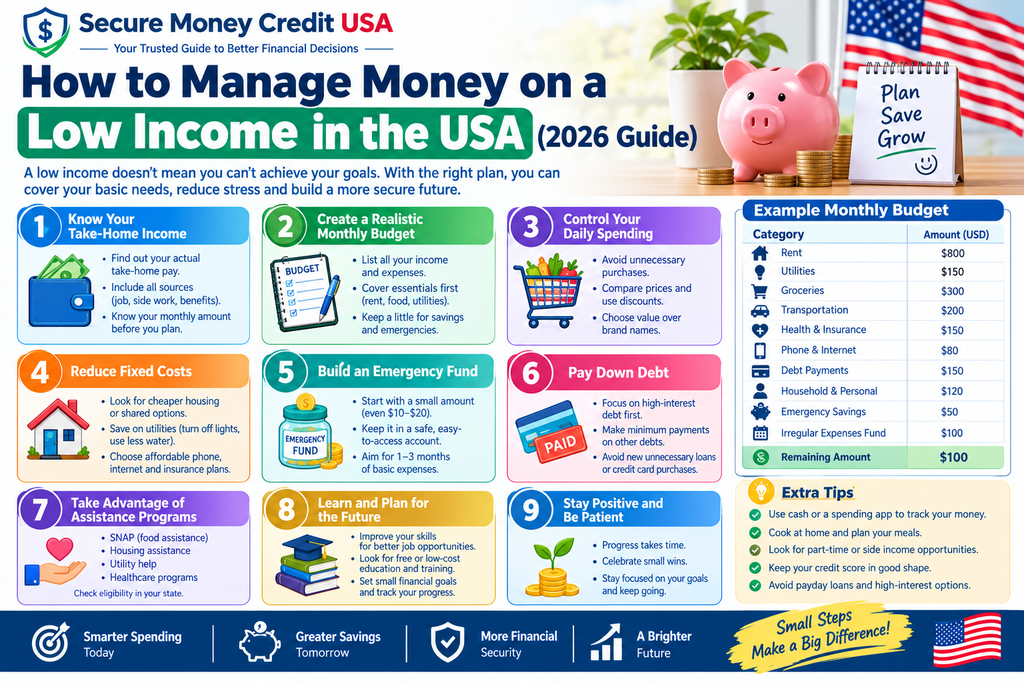
Example Monthly Budget on a Low Income in the USA
- Take-home income: $2,200
- Rent: $800
- Utilities: $150
- Groceries: $300
- Transportation: $200
- Health and insurance costs: $150
- Phone and internet: $80
- Debt payments: $150
- Household and personal expenses: $120
- Emergency savings: $50
- Irregular expenses fund: $100
- Remaining amount: $100
- Total planned expenses and savings: $2,100
- Money remaining: $100
This is an illustrative monthly budget. Actual expenses vary by household and location in the USA.
These figures are illustrative only. They are not official US averages or recommended amounts for every household.
Your actual housing, healthcare, transportation, and food costs may be significantly higher or lower.
The remaining $100 in this example can be assigned to additional essential expenses, a larger savings contribution, or debt repayment, depending on the household’s circumstances.
If your expenses exceed your income, identify the shortfall and investigate realistic options for reducing costs, increasing income, arranging payments, or obtaining eligible assistance.
Official resource: Consumer.gov provides guidance and a budget worksheet to help you create a monthly spending plan.
3. Prioritize Essential Expenses First
When money is limited, decide which expenses are most important to your health, safety, housing, and ability to earn income.
Essential expenses commonly include:
- Rent or mortgage payments
- Basic utilities
- Food and drinking water
- Necessary transportation
- Essential medications and medical care
- Required insurance payments
- Childcare needed for work
- Minimum contractual debt payments, when affordable
Not every household can pay every bill in full at the same time.
If you cannot cover all your obligations, consider the consequences of missing each payment. Prioritize immediate needs and expenses that protect your housing, health, safety, and ability to work.
Contact creditors, landlords, utility providers, or other billers as early as possible to ask about hardship arrangements, payment plans, or available assistance.
Do not assume that delaying a payment is harmless. Late fees, service interruptions, credit reporting consequences, or legal action may apply depending on the obligation and applicable law.
4. Track Every Expense for 30 Days
Many people underestimate how much they spend on small, frequent purchases.
Tracking your spending for one month can help you identify where your money goes.
Record expenses such as:
- Groceries
- Restaurants and takeout
- Coffee and snacks
- Fuel and public transportation
- Online shopping
- Streaming subscriptions
- Personal care products
- Bank fees
- Unexpected purchases
You can use a spreadsheet or a simple notebook.
At the end of the month, compare your actual spending with your original budget.
Look for expenses you can realistically reduce without compromising your health, safety, or essential needs.
For example, if you discover that several unused subscriptions are costing you $35 per month, canceling them could free up $420 over 12 months, assuming the savings continue.
Tracking expenses is not about feeling guilty. It is about understanding your financial habits and making informed decisions.
5. Reduce Grocery and Food Expenses
Food is an essential expense, but planning your purchases can sometimes help lower the cost of feeding your household.
Consider these practical strategies:
Plan meals before shopping. Prepare a weekly meal plan based on your schedule, budget, and ingredients already available at home.
Create a shopping list. A list helps you focus on the items you need rather than making unnecessary purchases.
Compare unit prices. Compare the price per ounce, pound, or other standard unit instead of choosing a product based only on its package price.
Choose affordable staples. Depending on your dietary needs, beans, lentils, oats, rice, eggs, frozen vegetables, and seasonal produce may be useful budget-friendly options.
Reduce food waste. Store food properly and plan meals that use ingredients before they spoil.
Use discounts carefully. Buy discounted items when they meet your needs, not simply because they are on sale.
Consider community resources. Eligible households may be able to access food assistance programs or local food banks.
Do not compromise necessary nutrition to meet an unrealistic food budget.
6. Lower Utility and Household Costs
Utility bills can place significant pressure on a limited household budget.
Depending on your circumstances, consider the following options:
- Turn off lights and equipment when they are not needed.
- Use energy-efficient lighting when practical.
- Adjust heating and cooling settings safely.
- Reduce water waste.
- Check for recurring service charges.
- Compare available phone and internet plans.
- Ask utility companies whether they offer hardship arrangements or payment plans.
Before changing providers, compare the full cost, contract terms, equipment charges, and cancellation fees.
Some eligible US households may qualify for assistance with energy bills through the Low Income Home Energy Assistance Program, commonly known as LIHEAP.
Program availability, application procedures, and eligibility vary by state and household circumstances.
Learn more through the official US government benefits website: https://www.usa.gov/benefits
7. Avoid High-Cost Debt Whenever Possible
when your income is insufficient to cover necessary expenses, borrowing can seem like the quickest solution.
However, some forms of borrowing are expensive and can make future budgets more difficult to manage.
Be cautious about:
- Payday loans
- High-cost installment loans
- Repeated cash advances
- Credit card cash advances
- Buy now, pay later purchases you cannot comfortably afford
- Loans with substantial fees or unfavorable repayment terms
Before borrowing, calculate the total amount you must repay, including interest and fees.
Check the payment schedule and determine whether the payments will leave enough money for rent, food, utilities, transportation, and other essential expenses.
If you already have expensive debt, consider contacting your creditors to discuss hardship options.You may also seek help from a reputable nonprofit credit counseling organization.
Before agreeing to a service, review its fees, qualifications, and terms.
Avoid companies that guarantee they can eliminate your debt or pressure you to stop communicating with creditors without clearly explaining the risks.
8. Pay Attention to Credit Card Spending
Credit cards can help manage purchases, but they are not additional income.
If you carry a balance, interest charges may increase the cost of your purchases.
To manage credit cards responsibly:
- Understand the interest rate and fees.
- Review your statements regularly.
- Pay at least the required minimum by the due date when possible.
- Pay the full statement balance when financially feasible to avoid interest on purchases when your account terms provide a grace period.
- Avoid using credit to cover recurring expenses unless you have a realistic repayment plan.
- Contact your card issuer if you are experiencing financial hardship.
If you cannot afford all your payments, prioritize essential needs and contact the card issuer to discuss available options.Do not assume that paying only the minimum will eliminate debt quickly.
The repayment period and total interest can be substantial, depending on your balance and interest rate.
For more guidance, read our related article: Best Credit Cards in USA for Beginners (2026 Guide).Best Credit Cards in USA for Beginners (2026 Guide)

9. Start an Emergency Fund With Small Contributions
An emergency fund is money reserved for unexpected expenses, such as a necessary car repair, urgent medical cost, or temporary loss of income.
Building an emergency fund can be difficult when most of your income goes toward basic necessities.
Start with a goal that fits your actual circumstances.
For example:
- First goal: Save $50.
- Next goal: Increase the balance to $100..
- Later goal: Work toward covering one week of essential expenses.
- Long-term goal: Gradually build savings that could cover several months of essential expenses, if possible.
These are examples, not mandatory targets. Your first priority may be covering essential bills or addressing overdue necessities.
If you can save $10 per week, you would contribute approximately $520 over 52 weeks, excluding interest and assuming you make every contribution.
Keep emergency money accessible and consider a suitable account with low or no maintenance fees.
If your income is extremely limited, saving even a small amount may not be possible every month. That does not mean you have failed. Focus first on meeting essential needs and improving your financial position where possible.
10. Look for Legitimate Financial Assistance Programs
Some US households may qualify for government benefits or community assistance based on income, household size, location, age, disability status, or other eligibility requirements.
Depending on your circumstances, resources may include:
SNAP: The Supplemental Nutrition Assistance Program helps eligible households purchase food.
WIC: The Special Supplemental Nutrition Program for Women, Infants, and Children provides qualifying nutrition support.
Medicaid: Eligible individuals may receive health coverage under federal and state program rules.
LIHEAP: Eligible households may receive assistance with energy costs.
Housing assistance: Certain federal, state, and local programs may help eligible households with housing expenses.
Unemployment benefits: Eligible workers who meet applicable state requirements may qualify for temporary unemployment benefits.
Availability and eligibility differ across programs. Applying does not guarantee approval.
Start with the official US government benefits finder: https://www.usa.gov/benefit-finder
Use official government websites or authorized local agencies when checking eligibility and submitting applications. Be cautious of anyone who asks you to pay a suspicious fee or provide sensitive information to guarantee benefits.
How to Manage Money on a Low Income in the USA (2026 Guide) Read More »